Skip to content
Free Shipping above ₹499 | All India Delivery

Fittonia Plant | Live Indoor Nerve Plant | 10cm Pot

4.00 ( 2  Reviews )
Original price Rs. 319.00 - Original price Rs. 319.00
Original price
Rs. 319.00
Rs. 319.00 - Rs. 319.00
Current price Rs. 319.00
SKU FITT-POT-010
Look closely at those leaves — each one is a tiny map, bright green edges traced all over with crisp white veins in a net-like pattern that no other houseplant quite replicates. What sets this white-veined Fittonia apart is that dramatic contrast: the vein network is bold and dense, covering every fleshy, oval leaf from edge to edge. Comes in a 10cm pot, perfectly sized for a study desk, bathroom shelf, or any bright-ish corner that needs life without taking up space. It's also one of the best air purifying plants you can bring home — beauty and cleaner air, all in one compact, bushy little package.
Watering

Water when the top layer of soil is dry.

Light

Fittonia thrives in low to medium indirect light — a bright spot away from direct sun is ideal. A sheer curtain over a sunny window gives it exactly the filtered light it loves.

Pet Friendliness

Pet Friendly — The plant causes no harm to your pets on contact or ingestion.

Fertilizer

Feed occasionally with a balanced fertilizer during the growing season.

Also Known As: Nerve Plant, Mosaic Plant

Color may appear slightly different in person due to photographic lighting and monitor settings.

The fittonia plant in this listing has small, oval leaves with a fleshy, textured surface — each leaf outlined in bright green and criss-crossed with crisp white veins that form a striking net-like pattern. At just 10cm, it arrives as a compact, bushy starter that's ready to sit on your desk, windowsill, or bathroom counter the moment it comes out of the box.

About the Fittonia: Variegated Foliage, Compact Charm

Commonly called the nerve plant, Fittonia (Fittonia albivenis) is a tropical creeper native to the rainforests of South America, where it grows beneath the forest canopy in warm, humid, low-light conditions — which is exactly why it adapts so naturally to Indian interiors. The variety in this listing produces oval leaves with brilliant white veins laid over a rich green base, creating the mosaic-like look that makes Fittonia instantly recognisable. It typically grows only 4–6 inches tall, making it one of the most genuinely compact houseplants you can own — no pruning anxiety, no outgrowing its spot. Its love of humidity also makes it a natural fit for bathrooms, terrariums, or grouped with other moisture-loving plants.

Fittonia as an Air Purifying Plant

A Pet Safe Houseplant for Indian Homes

One of Fittonia's most genuinely useful qualities is that it is completely safe around pets and children — no toxicity concerns, no need to keep it out of reach. For homes with curious cats or dogs, this makes it a rare find: a plant that looks this good and causes no harm on contact or ingestion. It's the kind of detail that matters when you're choosing what lives on your floor versus a high shelf.

Low Light Tolerant and Desk-Ready

Fittonia performs best in low to medium indirect light, which means it thrives in the kinds of spots most plants refuse — a north-facing window, a desk a few feet from a glass door, or a bathroom shelf with filtered light. If you place it near a sunny window, a sheer curtain is all it needs to stay happy. This makes it one of the most practical choices for Indian apartments where full sun isn't always on offer.

Humidity Lover That Thrives Where Others Struggle

India's monsoon months are practically Fittonia's favourite season — it genuinely loves the warm, humid air that makes other plants sulk. During drier months or in heavily air-conditioned rooms, a light misting or a pebble tray with water keeps it looking lush. Its compact size also makes it ideal for terrarium arrangements, where it creates a lush green-and-white carpet effect with minimal effort.

Also Known As: Nerve Plant, Mosaic Plant
Why Chhajed Garden

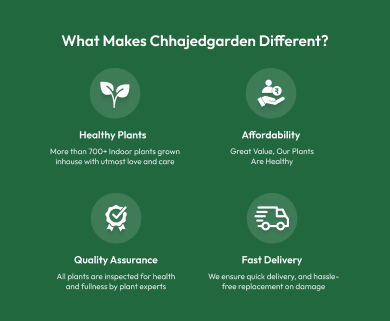
This Fittonia is grown in-house at Sanjay Nursery, with 40+ years of growing experience behind every plant we dispatch — rooted in cocopeat, well-nourished, and ready for your space the day it arrives. Every order is backed by our 7-day replacement guarantee, because we stand behind the quality of what we grow.

Once you've lived with those white-veined leaves catching the morning light, you'll wonder how your desk ever looked complete without them.

Frequently Asked Questions

Find answers to common questions

Fittonia does best in low to medium indirect light — a spot near a window with filtered light is ideal. Avoid direct afternoon sun, which can scorch the leaves and turn them brown and crispy.

Water when the soil surface just barely starts to dry — Fittonia likes constantly moist (but never soggy) soil. It will wilt dramatically if it dries out, but the good news is it bounces back quickly once you water it.

Take a 5–7cm stem cutting just below a leaf node, remove the lower leaves, and place it in moist potting mix or a glass of water in a warm, humid spot. Roots typically appear within 2–3 weeks, and the cutting can be potted up once they're 2–3cm long.

Yes — Fittonia is one of the few plants that genuinely tolerates low light without losing its colour or compact shape. A north-facing window or a spot a few feet back from a brighter window works perfectly.

Yellowing leaves on Fittonia are most often caused by overwatering or waterlogged soil — make sure the pot has drainage and you're letting the surface just barely dry before watering again. Less commonly, low humidity or too little light can also cause the leaves to lose their vibrancy.

Place the pot on a tray of wet pebbles, mist the leaves lightly every couple of days, or group it with other moisture-loving plants. In heavily air-conditioned rooms, keeping it in a bathroom with good indirect light is often the simplest solution.

With consistent moisture, humidity, and indirect light, Fittonia can live for several years as a houseplant — many plant parents keep them going for 3–5 years or longer. Pinching back leggy stems regularly keeps the plant bushy and encourages fresh, healthy growth.